Chapter 14 — Addressing Income and Wealth Inequality
Cambridge International AS & A Level Economics (9708) · Unit 3.3 · 4th edition coursebook
Learning objectives
- Explain the difference between income as a flow concept and wealth as a stock concept.
- Measure inequality in income and wealth with a Gini coefficient.
- Explain the economic reasons for inequality of income and wealth.
- Discuss policies that redistribute income and wealth, including the minimum wage, transfer payments, progressive income taxes, inheritance and capital taxes, and state provision of essential goods and services.
Key terms
- wealth
- A stock of assets that has been built up over time.
- Gini coefficient
- A numerical measure of income inequality.
- informal economy
- The part of the economy that is not regulated, protected or taxed by the government.
- minimum wage
- The least amount an employer can legally pay one of its workers; it is usually expressed as a wage rate per hour.
- transfer payment
- A payment made by the government to certain members of the community who may be unable to work or are in need of assistance.
- progressive tax
- One where the rate of taxation rises more than proportionately to the rise in income.
- inheritance tax
- A progressive tax on an inheritance or gift.
- capital tax
- A progressive tax paid annually on the difference between the buying and selling price of an asset.
14.1Income and wealth
You need to be clear on the difference between income and wealth. Income is the reward for the services of a factor of production (see Section 3.1). For labour, income takes the form of wages, salaries and bonuses. For other factors of production, income takes the form of rent, interest and profit.
Income is a flow concept. This is because the returns to the various factors of production are variable over any given period of time — they are measured per week, per month, or per year.
Wealth describes the stock of assets that someone has accumulated over time — for example, businesses, property, shares, gold and antiques. These assets provide security and, in some cases, an income stream for the future.
The two concepts are linked but distinct. Where wealth has come from differs between economies. In some economies, much of the wealth held by the richest individuals has come from businesses they own or control; in others, particularly high-income countries with a long industrial history, much of the wealth has been inherited from past generations of families.
It is easy to use the word 'wealth' when 'income' would be more accurate. Wealth is a stock of assets built up, often over a long period; income is a flow of payments to factors of production over a given time period. Keep the two ideas separate.
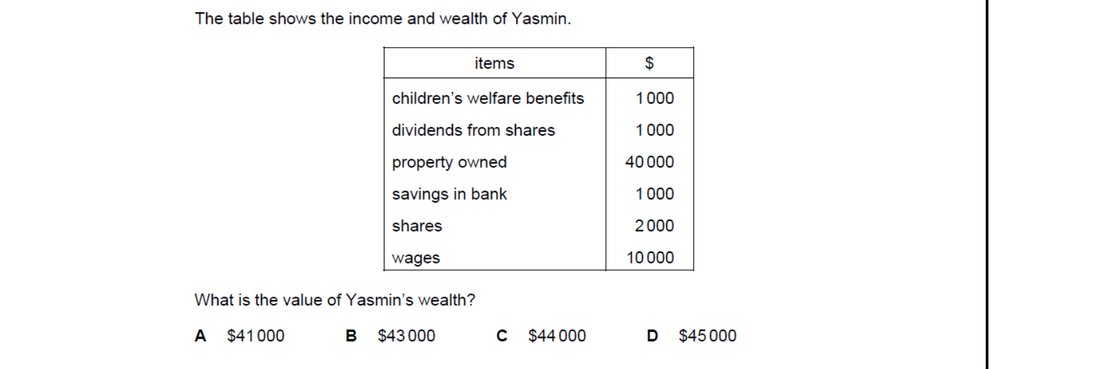
Wealth is a stock of assets, distinct from income flows. Sum only the asset items: property $40 000 + savings $1 000 + shares $2 000 = $43 000. Wages, dividends and welfare benefits are flows of income, not wealth, so they are excluded. Option B ($43 000) is correct; the other figures incorrectly add income items into the wealth total.
14.2Measuring income and wealth inequality
The Gini coefficient is a numerical measure of the extent of income inequality in an economy. If the income distribution in an economy is perfectly equal, the Gini coefficient takes the value 0. If all income accrues to just one person, the Gini coefficient takes the value 1. Both extremes are theoretical — they do not occur in the real world. The norm is for Gini coefficients to lie somewhere between 0 and 1, with smaller values indicating a more equal distribution. A Gini coefficient of 0.3, for example, indicates a more equal distribution of income than a coefficient of 0.5. The data can also be reported as percentages, with 100% representing total inequality. Some economists use a benchmark around 45% to distinguish economies where income is relatively concentrated from those where it is more evenly distributed.
The same idea — comparing the share of total income (or wealth) received by different parts of the population — can be applied to wealth. Wealth distributions, however, tend to be measured separately because the stock of assets is built up over a lifetime and accumulates differently from the year-to-year flow of income.
14.3Economic reasons for inequality of income and wealth
Economists agree that inequality of income and wealth acts as a barrier to economic growth and development. There are many reasons for this inequality. Some are economic; others are social, cultural and political. The economic reasons most relevant for the syllabus are listed below.
- A lack of formal employment opportunities, particularly for young people but also for those with professional skills. Without formal employment, workers have little access to a stable income or to the social-security benefits that come with it.
- Poor vocational training, which means that local industries cannot obtain the skilled labour needed to operate viably in national and international markets. Without a trained workforce, productivity and wages stay low.
- A lack of investment in education and health, which holds back the development of the human capital needed to support economic growth. Where households have to fund education and healthcare themselves, the poorest are usually excluded.
- Poor infrastructure — roads, railways, electricity supply, water supply, telecommunications — which prevents producers from reaching markets and prevents households from accessing basic services.
- A low rate of savings, which holds back both private-sector and public-sector investment. With limited savings, there is limited capital to be deployed productively.
- The inability of many people to obtain credit, which prevents them from funding small businesses, improving their skills, or investing in their own education. Without credit, households cannot move from low-productivity work into higher-productivity opportunities.
These causes interact. Poor infrastructure makes formal employment harder to access; low savings limit the credit that would otherwise be available; lack of education holds down productivity, which in turn holds down income. Untangling them requires action across several fronts at once — which is why the redistribution policies in §14.4 are typically used alongside investment in education, health and infrastructure.
14.4Policies to redistribute income and wealth
Governments use a range of policies to reduce inequality in the distribution of income and wealth. Most governments focus first on reducing income inequality; some also use policies that redistribute wealth. Many of these policies depend on funds generated from tax revenue, which has implications for what is feasible in any given economy.
The collection of taxes causes serious difficulties in most low-income countries and many middle-income countries, where the informal economy is large and only a small percentage of the population pays direct rather than indirect taxes. Corruption and tax evasion are also common. Together these factors limit the ability of governments to successfully implement policies that redistribute income and wealth.
Key concept link — regulation, equality and equity
There are various ways in which governments can reduce inequality in the distribution of income; the problem is that choice is largely determined by the limited resources available.
Minimum wage rates
A minimum wage is the legal minimum that an employer must pay an employee per hour. It is a rate before tax and any social-security deductions. Minimum wages are now widely applied across many economies. Employers who fail to pay the legal minimum can be fined or face other penalties.
Introducing a minimum wage can reduce poverty in any economy. In low-income and lower-middle-income countries, however, the policy reaches only the minority of workers who are employed in the formal sector. It has no effect in the large informal sectors that dominate these economies, and no effect on self-employed workers or small businesses staffed by family members.
Critics argue that introducing a minimum wage causes unemployment. The argument is illustrated in Figure 14.3. The competitive equilibrium wage is W. If the government sets a minimum wage of W₁ above this rate, employers will demand only Q₁ workers while Q₂ workers would be willing to supply their labour at the new rate. The difference (Q₁ to Q₂) is the unemployment caused by the policy. Workers who keep their jobs are better off; but fewer jobs are available overall.

A transfer payment is a payment made with no good or service supplied in return. A parent's allowance to a school-age child is exactly that — money handed over without a productive transaction. Advertising expenditure buys promotion services, rent buys the use of land, and wages buy labour. Only option B involves no productive exchange, so it is the transfer payment.

A transfer payment redistributes income without any productive activity being exchanged for it. The defining feature is therefore that nothing is produced in return. Cash form is not essential (benefits in kind also count); a banking transaction is incidental; and although most transfers come from government, that is not a necessary condition (e.g. private gifts). Option D — it must relate to a non-productive activity — captures the essential criterion.
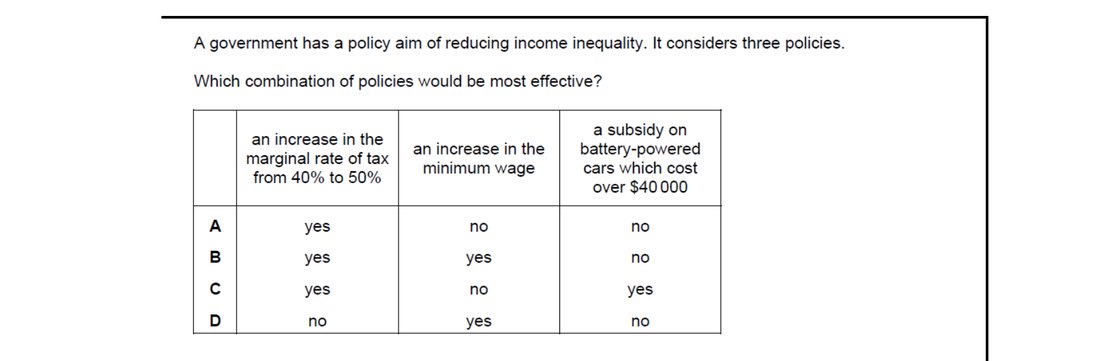
Reducing income inequality requires policies that take more from higher earners or raise the floor for lower earners. Raising the top marginal income-tax rate from 40% to 50% is progressive; increasing the minimum wage lifts the lowest-paid. A sales tax on battery-powered cars (typically bought by higher-income households) is too narrow and indirect to materially reduce inequality. Option B — yes/yes/no — selects the two effective redistributive tools.
14.4.1Transfer payments
A transfer payment is a payment from tax revenue received by certain members of the community. Transfer payments are not made through the market — no production takes place in exchange for them. Their purpose is to produce a more equitable distribution of income. The main recipients are vulnerable groups such as the elderly, the disabled, the unemployed, and those on the lowest incomes. The payments transfer income from people who are able to work and pay taxes to those who are unable to work or who need assistance.
Examples of transfer payments include:
- old age pensions
- unemployment benefits
- housing allowances
- food coupons
- child benefits.
The extent to which transfer payments can be paid depends on how much tax is collected and how many people have paid into the tax system. In low-income and lower-middle-income countries this is constrained by a narrow tax base. Pension and social-security coverage in many such economies is limited to the formal sector and therefore reaches only a small percentage of the population. Workers in the informal economy are typically not covered. Cross-country provision varies widely — some lower-middle-income countries provide little or no assistance even to government workers.
The effect of transfer payments on the market is debated. On one side, they are necessary to protect the most vulnerable groups and they produce less poverty and a more equitable distribution of income. On the other side, unemployment benefits and benefits paid to those on the lowest incomes can act as a disincentive to accepting work, raising the unemployment rate. If output is then less than it might be, there is a form of inefficiency that has to be weighed against the equity gains.
14.4.2Progressive income taxes, inheritance and capital taxes
The tax system can also be used to reduce inequalities in income and wealth. The main tool is the progressive tax — a tax under which the rate rises more than proportionately as income (or value) rises. The clearest example is a progressive income tax: those on higher incomes pay a higher rate or percentage of their income than those on lower incomes. Where the top rate of income tax might be 80%, lower rates might be 40% or 20%. The result is that income differentials after tax are narrower than they were before tax.
Most national income-tax systems are progressive in design: the average rate of tax rises as income rises. The main concern about progressive taxes is the disincentive effect. Very high marginal tax rates may discourage work, saving and investment, and may even encourage high earners to relocate to countries with more favourable tax regimes.
Taxes can also be used to reduce wealth inequalities directly. An inheritance tax charges a person on the wealth they receive when they inherit more than a certain threshold; the tax is paid to the government. A capital tax is paid on the financial gain a person realises on assets such as property or financial portfolios over the period during which they have been owned. The overall impact of inheritance and capital taxes on wealth concentration tends to be relatively small.
14.4.3State provision of essential goods and services
Inequality can also be reduced by the government directly providing certain important goods and services, often free of charge to the user, with the cost met from general taxation. Where these goods and services are used roughly equally by all citizens, those on the lowest incomes gain most as a percentage of their income. Inequality is therefore lowered.
The two largest examples of free provision in many economies are healthcare and junior and secondary education. These markets are characterised by various market failures, but the failures do not by themselves justify free provision to the consumer. The justification is on grounds of equity: the view that everyone should have access to a basic level of healthcare and education regardless of income and wealth. Where this view is accepted, the services are provided universally and free at the point of use. They are the material equivalent of monetary universal benefits.
Some governments also provide other goods to support those on low incomes. This can include food, other essential items, water and, in some cases, housing. As with healthcare and education, the justification is grounded in equity rather than in efficiency.
End-of-chapter practice
Past-paper questions from CIE 9708. Pick A, B, C or D. Answers are saved on this device — press Download report (PDF) at the top to save them.

A transfer payment is a redistribution of income from government to recipients with no good or service produced in return. Welfare benefits fit this exactly. Spending on hospitals and motorways purchases real services/infrastructure (factor payments to staff and contractors); the minimum wage is a regulated price of labour, not a payment by government. Hence option D — welfare benefits — is correct.

Transfer payments are unilateral payments where no good or service is produced in exchange. A government pension payment is paid out of taxation to retirees who supply no current output, so option B is the transfer payment. Indirect taxes flow from households TO government, inter-firm payments are for raw materials (productive exchange), and salaries reward labour services — all involve production.
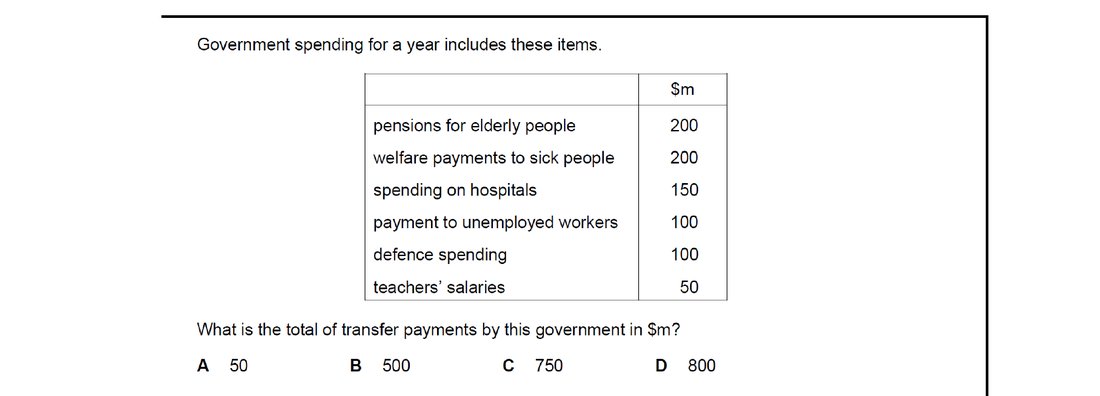
Transfer payments redistribute income without payment for output. Add the items where recipients supply no current good or service: pensions $200m + welfare to the sick $200m + payments to the unemployed $400m = $800m. Hospital spending, defence and teachers' salaries are factor payments for services rendered. Option D ($800m) is therefore the correct total.

Wealth taxes fall on the stock of assets a person owns, whereas income taxes fall on flows. A personal asset tax (option D) is levied directly on holdings such as property or shares — a stock. Company profits tax and individual direct (income) tax both fall on income flows, and a goods and services tax falls on the flow of expenditure. Only D taxes a stock of wealth.

A transfer payment is government redistribution where no good or service is produced in return. Student grants paid by the government (option D) fit this definition: recipients receive income without supplying output. Moving savings between bank accounts is a portfolio change, loan repayments service a private debt, and transport payments purchase a productive service — none involves government redistribution without production.
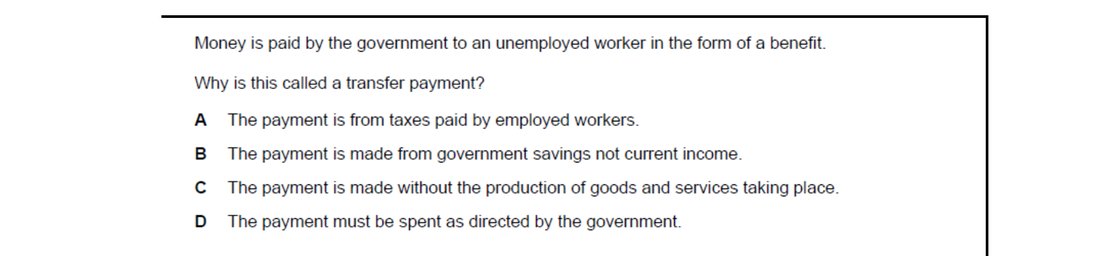
The defining feature of a transfer payment is that money changes hands without any corresponding production of goods or services — the recipient does not supply output in return. Option C captures this precisely. The source of funds (taxes vs savings) and any spending conditions attached are incidental; what matters is the absence of a productive exchange, which is why unemployment benefit qualifies as a transfer.
Attempt the practice questions above to build your score.
Self-evaluation checklist
After studying this chapter, you should be able to:
- Describe the difference between income and wealth.
- Understand that income is the flow of returns to factors of production.
- Understand that wealth is the stock of accumulated assets.
- Explain that the Gini coefficient can be used to measure the extent of income inequality in an economy.
- Explain the economic reasons for inequality of income and wealth.
- Discuss how governments use many different policies to try to produce a more equal distribution of income and wealth.
Want more practice? Drill this chapter's past-paper MCQs (62 questions) →